

A Comprehensive Guide to Medical Device Registration in Indonesia
Introduction
Expanding into the Indonesian market with medical devices requires careful navigation of regulatory processes. Indonesia’s Ministry of Health (Kementerian Kesehatan) governs medical device registration, ensuring products meet safety, quality, and performance standards before they can be sold to the public. In this comprehensive guide, we will walk through the step-by-step process of registering a medical device in Indonesia, covering documentation, classification, timelines, costs, and tips for smooth market entry.
1. Understanding the Regulatory Framework for Medical Devices in Indonesia
The Indonesian medical device registration process is primarily overseen by the Ministry of Health, which ensures that all medical devices meet the required standards for safety, effectiveness, and quality. Indonesia uses the ASEAN Medical Device Directive (AMDD) to harmonize regulations across Southeast Asia. As part of this, medical devices are classified into four risk classes (A, B, C, D), each with specific documentation and regulatory requirements.
- Class A (Low Risk): These devices have minimal regulatory oversight. Examples include non-sterile devices like bandages and thermometers.
- Class B (Low to Moderate Risk): Devices that are moderately invasive, such as syringes or dental instruments.
- Class C (Moderate to High Risk): These are more complex devices, like diagnostic imaging tools and ventilators.
- Class D (High Risk): Life-sustaining devices, such as pacemakers or heart valves, requiring the most stringent testing and evaluation.
Each classification determines the documentation required, the complexity of the registration process, and the timeline for approval. Understanding your device’s classification is critical for ensuring you meet the appropriate regulatory compliance Indonesia demands.
2. Required Documentation for Medical Device Registration in Indonesia
To ensure a smooth registration process for medical product registration Indonesia, manufacturers must provide the following documentation, tailored to the device’s risk class:
- Corporate Documents: This includes but not limited to the company’s legal registration, business licenses, and Good Manufacturing Practice (GMP) certificates. It is also necessary to provide a Letter of Authorization (LoA) from the manufacturer if using a local distributor or representative.
- Technical Documentation: Detailed technical specifications, device description, intended use, contraindications, and risk analysis are required for all devices. For Class B, C, and D devices, more extensive clinical data may be necessary, such as safety and efficacy studies or trial data.
- ISO 13485 Certification: This quality management standard ensures the manufacturer’s processes meet international regulatory standards.
- Labelling Compliance: Labels must be provided in Bahasa Indonesia and meet the local requirements for product safety and usage instructions. All labels must also include the manufacturer’s details, product specifications, and warnings.
Depending on the class of the device, additional documentation may be required. For instance, Class C and D devices may need local clinical evaluations or testing at accredited Indonesian laboratories, especially for devices that emit radiation or are invasive.
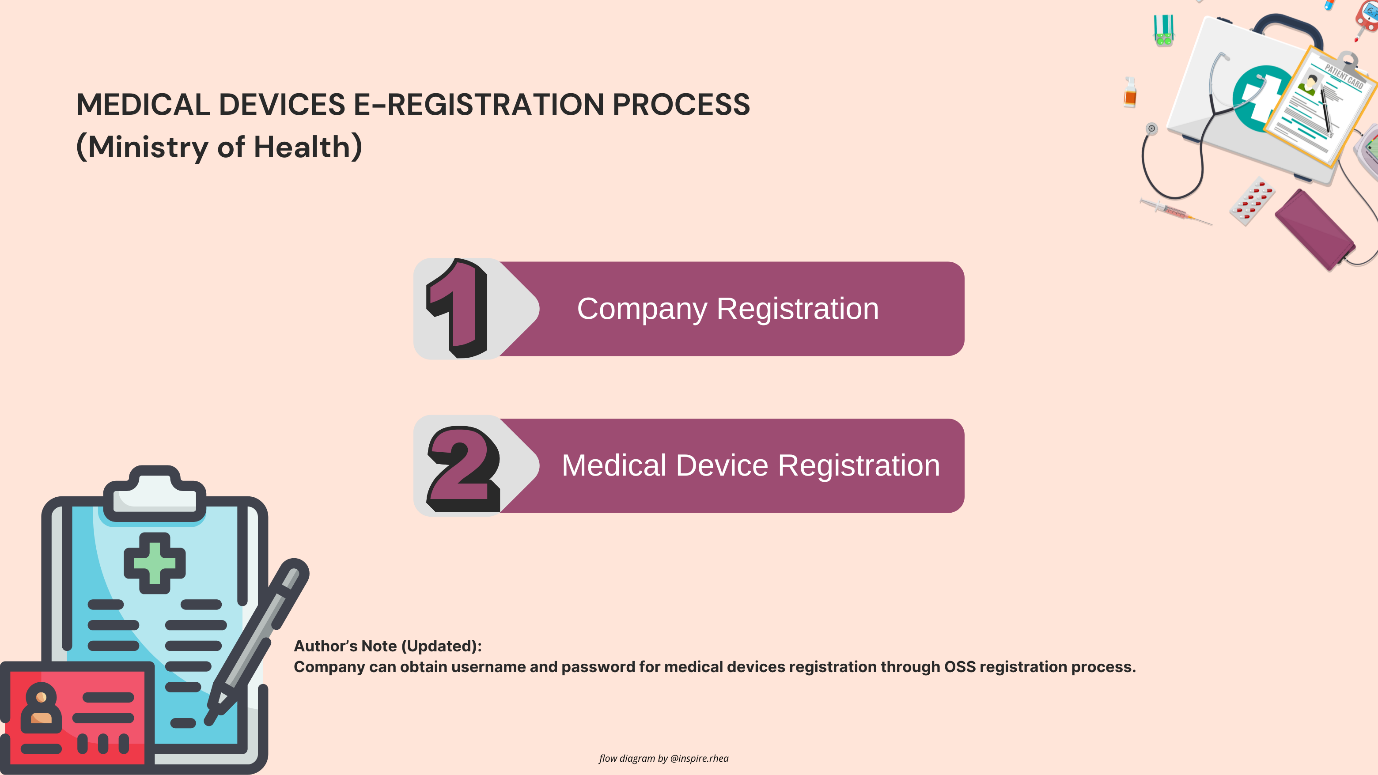
3. Step-by-Step Process for Registering a Medical Device in Indonesia
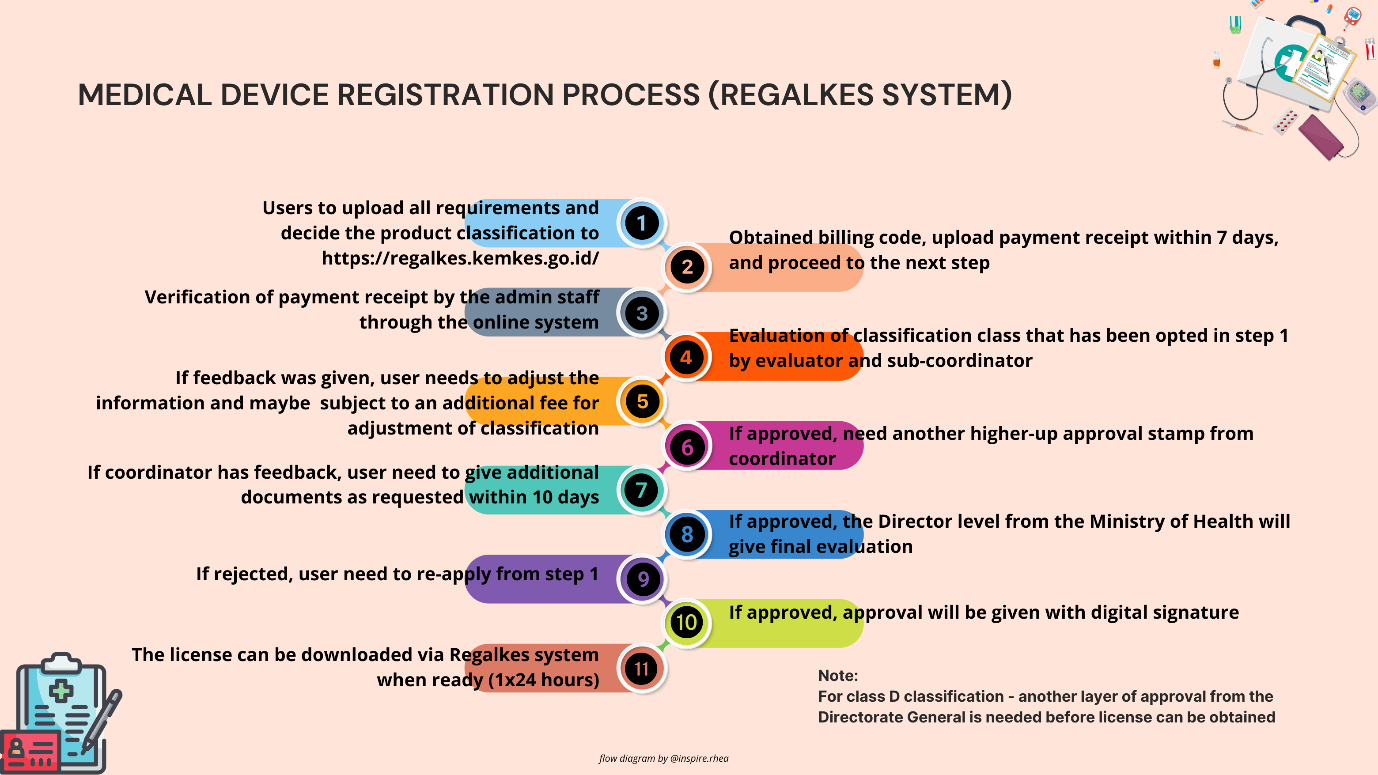
The medical device registration process in Indonesia is managed through the Regalkes platform (https://regalkes.kemkes.go.id/)n , an online system that streamlines the submission and tracking of applications. Here’s a breakdown of the essential steps:
- Class A: 45 days
- Class B: 90 days
- Class C: 100 days
- Class D: 120 days
If additional information is required, the Ministry will notify the applicant and request the necessary documents. Applicants have 10-15 working days to submit the required documents for re-evaluation.
5. Issuance of Nomor Izin Edar (NIE): Once the Ministry of Health approves the registration, it will issue the Nomor Izin Edar (NIE), a regulatory license required for legally marketing the device in Indonesia. The license is valid for up to 5 years, after which a renewal process is required.
- Class D: 120 days
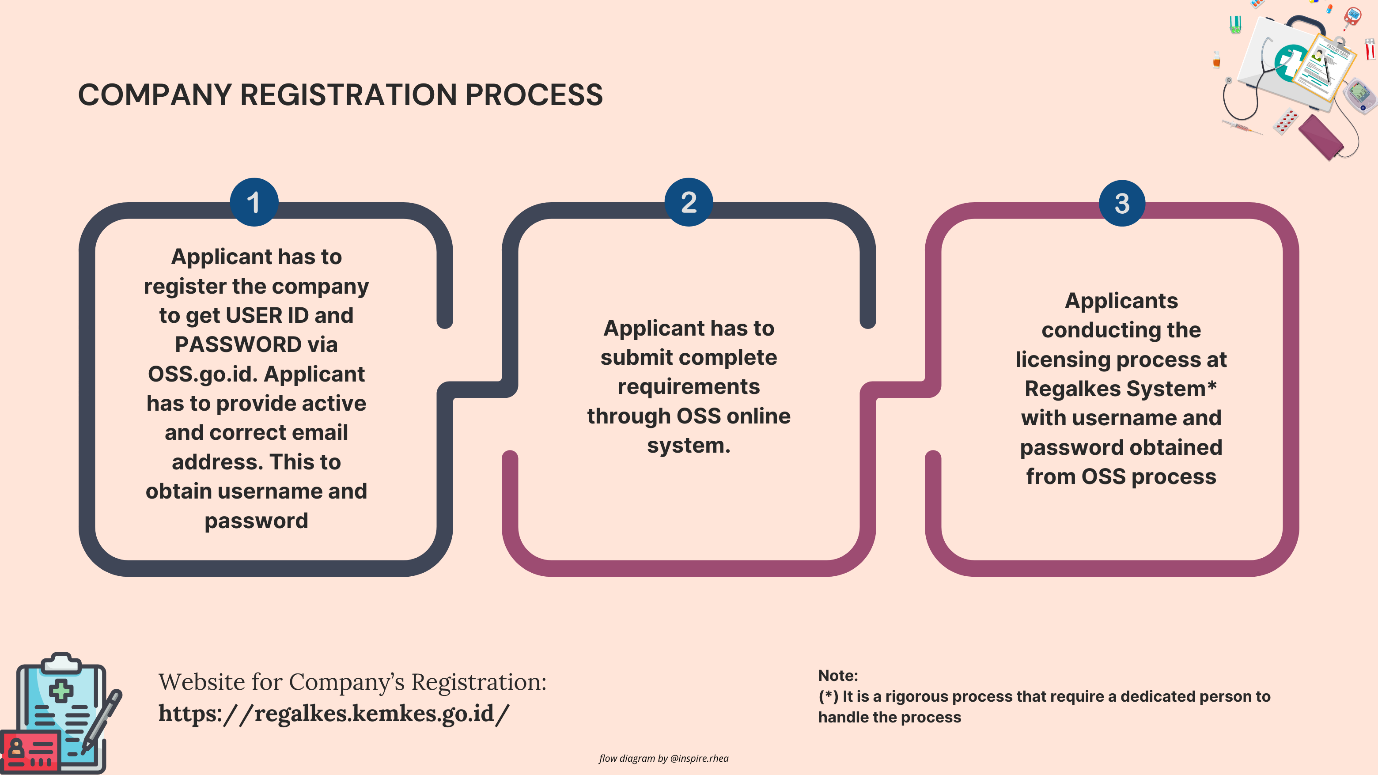
- Image 3: General Step Prior to Medical Devices Registration
4. Medical Device Certification Indonesia: Costs and Timelines
The timeline for medical device certification Indonesia can vary depending on the device class. Typically, the registration process is faster for Class A devices and slower for Class C and Class D devices due to the more rigorous testing and documentation requirements.
Here’s a quick summary of costs and timelines:
- Class A: Cost USD 125, processing time 1-2 months.
- Class B and C: Cost USD 225, processing time 3-4 months.
- Class D: Cost USD 350, processing time 4-6 months.
Additionally, device renewals typically cost IDR 1,000,000 (USD 75) and must be completed every 5 years.
5. e-Catalogue Registration: A Competitive Advantage
For businesses aiming to supply medical devices to public hospitals and healthcare institutions, e-catalogue registration Indonesia is an essential step. The e-catalogue is an online procurement system used by the Indonesian government to purchase medical products from registered manufacturers.
To register in the e-catalogue, businesses must meet specific Good Distribution Practice (GDP) requirements and provide comprehensive documentation, including the medical device’s Nomor Izin Edar (NIE). Listing in the e-catalogue offers several advantages:
- Government Access: Public hospitals and healthcare facilities use the e-catalogue to source medical devices, providing manufacturers with a direct link to these institutions.
- Market Visibility: Devices registered in the e-catalogue are prioritized for government procurement, which can significantly increase sales volume.
- Reduced Markups: When devices are listed in the e-catalogue, there is no room for regional dealer margins, improving pricing and competition.
6. Challenges in the Medical Device Registration Process
While the medical device registration Indonesia process is straightforward, there are some common challenges that businesses may face:
- Language Barriers: All documents must be translated into Bahasa Indonesia, and failure to provide accurate translations can lead to delays.
- Local Testing: For Class C and D devices, some may require testing in local accredited laboratories, adding to the cost and time required for approval.
- Distributor and License Transfer Issues: Once a distributor has been selected, switching to another distributor can be challenging. The license is typically non-transferable and may require reapplication, causing significant delays.
- Complex Documentation: For higher-risk devices, such as Class D, companies must submit more comprehensive clinical data, making the documentation process complex and time-consuming.
Conclusion
Successfully navigating the medical device registration Indonesia process is key for businesses looking to enter the market. By understanding the device classification system, preparing the correct documentation, and following the necessary steps through the Regalkes platform, companies can achieve smooth market entry. Additionally, registering in the e-catalogue can further enhance access to public institutions, offering a competitive advantage in the Indonesian healthcare sector.
With thorough preparation and a clear understanding of the regulatory requirements, businesses can confidently enter the Indonesian market and bring their medical products to consumers in this rapidly growing healthcare landscape.
- Set Up an Account on Regalkes: Begin by creating an account on the Regalkes platform. This requires providing business details and the authorized representative’s contact information. For foreign manufacturers, it is mandatory to appoint a local distributor who holds the necessary Medical Device Distributor License (MDDL).
- Prepare and Upload Documentation: After account setup, submit all the required documents through the Regalkes platform. The documentation should be complete and accurate to avoid delays in processing. Any missing or incorrectly translated documents can lead to rejection or extended review periods.
- Pay the Registration Fee: Upon submission, the Ministry of Health generates an invoice for the application fee. Class A devices typically cost around IDR 1,500,000 (USD 125), Class B and C devices cost about IDR 3,000,000 (USD 225), and Class D devices are priced at IDR 5,000,000 (USD 350). Payments must be made within 7 calendar days of receiving the invoice.
- Review and Evaluation: The Ministry of Health will evaluate the submitted documentation, and the review period varies depending on the class of the device:
- Class A: 45 days
- Class B: 90 days
- Class C: 100 days
- Class D: 120 days
If additional information is required, the Ministry will notify the applicant and request the necessary documents. Applicants have 10-15 working days to submit the required documents for re-evaluation.
5. Issuance of Nomor Izin Edar (NIE): Once the Ministry of Health approves the registration, it will issue the Nomor Izin Edar (NIE), a regulatory license required for legally marketing the device in Indonesia. The license is valid for up to 5 years, after which a renewal process is required.
- Class D: 120 days
- Image 3: General Step Prior to Medical Devices Registration
4. Medical Device Certification Indonesia: Costs and Timelines
The timeline for medical device certification Indonesia can vary depending on the device class. Typically, the registration process is faster for Class A devices and slower for Class C and Class D devices due to the more rigorous testing and documentation requirements.
Here’s a quick summary of costs and timelines:
- Class A: Cost USD 125, processing time 1-2 months.
- Class B and C: Cost USD 225, processing time 3-4 months.
- Class D: Cost USD 350, processing time 4-6 months.
Additionally, device renewals typically cost IDR 1,000,000 (USD 75) and must be completed every 5 years.
5. e-Catalogue Registration: A Competitive Advantage
For businesses aiming to supply medical devices to public hospitals and healthcare institutions, e-catalogue registration Indonesia is an essential step. The e-catalogue is an online procurement system used by the Indonesian government to purchase medical products from registered manufacturers.
To register in the e-catalogue, businesses must meet specific Good Distribution Practice (GDP) requirements and provide comprehensive documentation, including the medical device’s Nomor Izin Edar (NIE). Listing in the e-catalogue offers several advantages:
- Government Access: Public hospitals and healthcare facilities use the e-catalogue to source medical devices, providing manufacturers with a direct link to these institutions.
- Market Visibility: Devices registered in the e-catalogue are prioritized for government procurement, which can significantly increase sales volume.
- Reduced Markups: When devices are listed in the e-catalogue, there is no room for regional dealer margins, improving pricing and competition.
6. Challenges in the Medical Device Registration Process
While the medical device registration Indonesia process is straightforward, there are some common challenges that businesses may face:
- Language Barriers: All documents must be translated into Bahasa Indonesia, and failure to provide accurate translations can lead to delays.
- Local Testing: For Class C and D devices, some may require testing in local accredited laboratories, adding to the cost and time required for approval.
- Distributor and License Transfer Issues: Once a distributor has been selected, switching to another distributor can be challenging. The license is typically non-transferable and may require reapplication, causing significant delays.
- Complex Documentation: For higher-risk devices, such as Class D, companies must submit more comprehensive clinical data, making the documentation process complex and time-consuming.
Conclusion
Successfully navigating the medical device registration Indonesia process is key for businesses looking to enter the market. By understanding the device classification system, preparing the correct documentation, and following the necessary steps through the Regalkes platform, companies can achieve smooth market entry. Additionally, registering in the e-catalogue can further enhance access to public institutions, offering a competitive advantage in the Indonesian healthcare sector.
With thorough preparation and a clear understanding of the regulatory requirements, businesses can confidently enter the Indonesian market and bring their medical products to consumers in this rapidly growing healthcare landscape.