

Standfirst
A China-based in-vitro diagnostics company needed separate Ministry of Health marketing authorisations for nine rapid tests from two manufacturers, using documents written for other markets. Despite a government system outage, a two-per-day submission cap and two rounds of evaluator questions, all nine products were approved by October 2026, about seven months after work began.
Company snapshot
| Industry | In-vitro diagnostics (IVD), point-of-care rapid test kits |
| Country of origin | China (company and products) |
| Product category | Medical device: IVD rapid tests for infectious-disease screening (hepatitis B, hepatitis C, syphilis, dengue), pregnancy (hCG) and multi-drug (drugs-of-abuse) screening |
| Portfolio | 9 products from two manufacturers (the company and a partner OEM) |
| Company size | Not provided |
| Registration | Ministry of Health medical device marketing authorisation (izin edar) for each product |
| Duration | About 7 months, April to October 2026 |
The article
By late July 2026, nine medical device dossiers were drafted and ready, but nothing could be filed. Indonesia’s national business-licensing system (OSS) and the Ministry of Health’s registration website had been down, and they stayed down until 24 July.
When the systems came back, a China-based in-vitro diagnostics (IVD) company had all nine products entered within days. By October 2026, every one of its rapid tests had a Ministry of Health marketing authorisation.
One portfolio, nine dossiers, two manufacturers
The company develops point-of-care rapid diagnostic tests and sells them to international distributors. For Indonesia, it chose not to register one product at a time. It wanted to open the market for its whole rapid-test portfolio at once, working with a local distributor.
The portfolio covered infectious-disease screening (hepatitis B, hepatitis C, syphilis and dengue), a pregnancy (hCG) test and two multi-drug (drugs-of-abuse) screening panels. Some products came from a partner original equipment manufacturer (OEM), so one registration project involved two manufacturers.
In Indonesia, these tests are regulated as medical devices. Each one needed its own marketing authorisation (izin edar) from the Ministry of Health before it could be imported or distributed. That meant nine separate applications, each with its own clinical and performance evidence.
Three problems stood out from the start:
- Documents built for other markets. The company’s files had been prepared elsewhere and did not map one-to-one onto Indonesian requirements.
- Legalised documents with long lead times. Letters of Authorisation (LoA) and Certificates of Free Sale (CFS) had to be legalised and kept consistent across all nine products. The apostille step alone takes about two to three weeks.
- A planned change after approval. The company intended to switch to non-CE packaging once the first approvals were in, so the route for a post-approval change (a variation) had to be understood before filing.
Starting with the slowest paperwork
The company worked with Product Registration Indonesia (PRI) on the full process: dossier review and gap analysis, guidance on legalised documents, submission, and follow-up with Ministry evaluators through to approval. Every product was filed as a medical device marketing authorisation for IVD products, through the Ministry of Health’s online registration system.
Work began in April 2026 with a review of the company’s first-round dossier files against a shared checklist. At the same time, the team set out exactly what the legalised LoA and CFS needed: what had to be marked and what had to be translated. That put the longest-lead documents in motion while the technical files were still being checked.
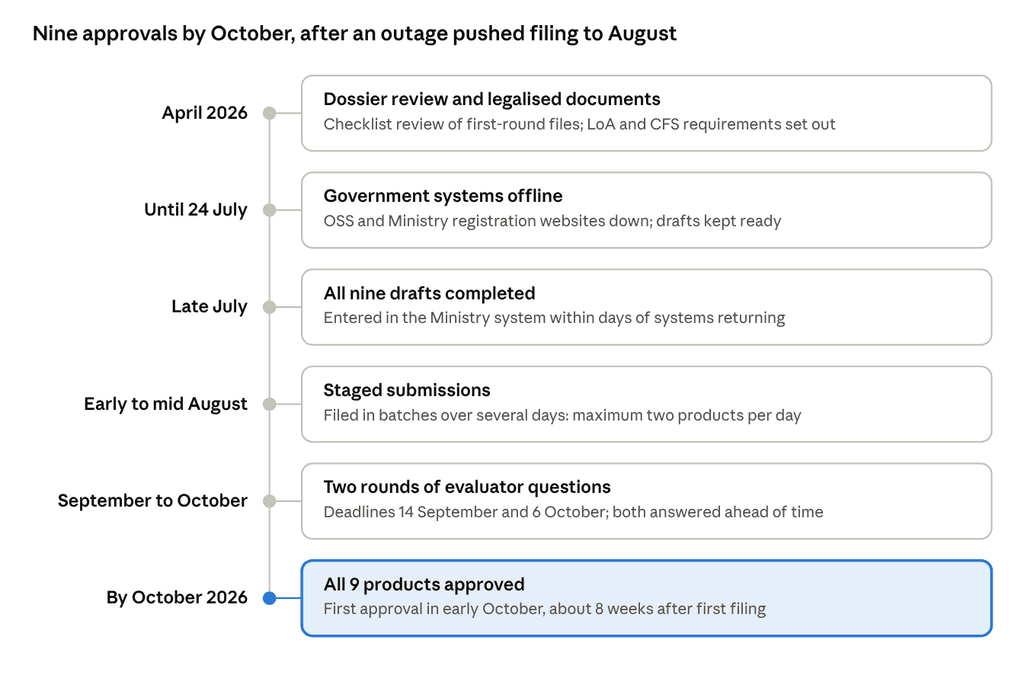
Registration timeline · April to October 2026 (phases, not to scale)
Legalised documents started in April, but the system outage meant submissions could only begin in August.
An outage, then a queue
The first obstacle was outside anyone’s control. The OSS and Ministry registration websites were down until 24 July 2026. Rather than wait, the team kept all nine drafts ready in the Ministry system, so every product was entered within days of the systems returning.
The second was a capacity limit. The Ministry system accepts a maximum of two product submissions per day, so the portfolio went in as staged batches over several days in early to mid August. Each product was then tracked against the Ministry’s 30- and 45-working-day evaluation clocks, with status reported back to the company.
Two rounds of evaluator questions
Evaluators returned two rounds of additional-data requests. The first, covering the drugs-of-abuse panels and infectious-disease tests, had a 14 September deadline.
The second, for the hepatitis tests, was due on 6 October and was more demanding. It asked for:
- complete raw clinical data
- the clinical investigator’s CV
- cross-reactivity data
- genotype-specific limit-of-detection data
- sworn translations of supporting literature
Responses to both rounds were submitted ahead of the deadlines.
The pause that didn’t happen
When one product drew further questions mid-review, the company considered pausing it. PRI advised against this. The government fee is not refundable, and pausing would have meant restarting the whole process later. The company kept going, and that product was registered too.
Nine approvals by October
The measurable outcomes:
- 9 products approved by October 2026, about seven months after the April 2026 kickoff.
- First approval at the start of October, roughly eight weeks after the first submissions. That was consistent with the 45-working-day evaluation estimate.
- Both rounds of evaluator data requests were answered ahead of the Ministry’s deadlines.
- Marketing authorisation numbers are confidential.
With the authorisations in place, the company can now legally import and distribute its rapid tests in Indonesia. PRI also advised it on certificate details and post-approval changes once the approvals came through.
“Thank you for your support throughout this process,” the company’s regulatory affairs team wrote in October 2026.
Key takeaways
- Align product names and types across every document before you submit. The evaluator follows the CFS and LoA. If a product name or type differs from the instructions for use, correcting it later means new legalised documents and a variation.
- Treat legalised documents as the critical path. Apostille, translation and marking the product to be registered on the LoA and CFS take weeks. Start them alongside the dossier review, not after it.
- Prepare IVD clinical evidence before evaluators ask. In this project they asked for raw clinical data, investigator CVs, cross-reactivity data, genotype-specific limit-of-detection data and sworn translations. Fast answers keep the clock moving.
- Have drafts ready and plan around system limits. An outage and a two-per-day submission cap shaped this timeline. Ready drafts and staged batches meant no time was lost when the systems returned.
- Think twice before pausing mid-review. The government fee is not refundable, and a pause can mean starting again. Here, continuing led to approval.
Looking ahead
The company’s next step is the planned switch to non-CE packaging, which will go through the Ministry of Health’s variation process. Because that change was mapped out before filing, the company enters it knowing the route.
About this case study
This case study is based on a 2026 registration project supported by Product Registration Indonesia. The company, a China-based developer of point-of-care IVD rapid tests that sells through international distributors, is not named at its request. Product, manufacturer and distributor names, fees and marketing authorisation numbers have been withheld.