

Standfirst
A beauty importer founded in 2026 wanted to bring a Korean skincare product to Indonesia, but it held none of the licences needed before a cosmetic can be notified. By running document collection alongside a three-stage licensing sequence, it secured its importer standard certificate in October 2026 and is now one step from filing the product notification.
Company snapshot
| Client | A newly established Indonesian beauty importer (founded 2026) |
| Industry | Skincare distribution in Indonesia |
| Manufacturer | Based in South Korea |
| Product category | Cosmetics: a Korean skincare product |
| SKUs | 1 |
| Company size | Not provided |
| Permits involved | Cosmetic importer standard certificate; applicant recommendation letter from the regional BPOM office; BPOM cosmetic notification |
| Status (November 2026) | Importer standard certificate issued; recommendation letter under verification; notification not yet filed |
The article
When a South Korean skincare manufacturer saw the list of documents Indonesia required, it pushed back. The file looked heavier than anything it supplied for other markets.
For the Indonesian importer that wanted to sell its product, that reaction mattered. Keeping the supplier on board was the first step in a project where every stage depended on the one before it.
Two licences before a single product
The importer was founded in 2026 to import and distribute a Korean skincare brand in Indonesia. Its first product was a Korean skincare product, regulated as a cosmetic.
To sell a cosmetic in Indonesia, the product needs a notification from the Indonesian Food and Drug Authority (BPOM). Once the notification is issued, the importer can bring the product in and sell it. But the company had no cosmetics distribution licence and no status as a notification holder.
A brand-new importer has to put two things in place before any product can be notified:
- A cosmetic importer standard certificate, which confirms the company’s distribution facility meets BPOM’s requirements.
- An applicant recommendation letter from the regional BPOM office.
Neither existed yet. At the same time, the manufacturer was used to lighter dossiers in other markets and found the Indonesian document list heavy. Without a clear explanation, that reaction could have slowed the supply of the documents the importer needed.
A three-stage roadmap from the first month
The importer worked with Product Registration Indonesia (PRI), with PRI’s legal team supporting checks on the company set-up. In June 2026, PRI shared a requirements checklist and a three-stage roadmap:
- The importer standard certificate
- The applicant recommendation letter from the regional BPOM office
- Product notification in the BPOM system
The product information document for the notification follows BPOM Regulation No. 17 of 2023 (PerBPOM 17/2023).
From July to September, the work focused on the company, its premises and its standard operating procedures (SOPs). PRI drafted the facility SOPs and listed what BPOM expects of the technical person and the premises.
The importer standard certificate was issued in October 2026. The recommendation-letter request was then filed and is now under verification by the regional BPOM office.
Reframing the dossier for the manufacturer
While the licences moved forward, the manufacturer’s concern about dossier size needed an answer. PRI walked the manufacturer through the cosmetic notification route and offered to help with any item it could not supply.
“PRI explained the notification route with the regulation behind it and told us which documents were needed first, which kept the supplier on board,” a representative of the importer said.
Collecting documents while the licences moved
Because each licensing stage unlocks the next, waiting for one to finish before gathering documents would have pushed the product date further out. Instead, document collection ran in parallel.
The manufacturer’s first document set arrived in late September. It included:
- raw-material certificates of analysis (CoA)
- a manufacturing process summary
- an explanation of the batch coding
PRI then requested stability reports, which show how a product holds up over time under set storage conditions, along with the packaging artwork. The manufacturer asked which climatic zone, conditions and test duration applied. PRI asked for accelerated and 24-month long-term stability data.
Where the project stands
The product notification has not yet been filed. What has been achieved so far:
- Importer standard certificate issued in October 2026, the first of the three licensing stages.
- Recommendation-letter request filed and under verification by the regional BPOM office.
- First manufacturer document set received in late September 2026, with stability reports and packaging artwork requested.
- One SKU prepared for BPOM cosmetic notification.
The notification will be submitted once the recommendation letter is issued. The current estimate is 20 working days for manufacturer registration plus 30 working days for the product. These are estimates, not guaranteed timelines.
Once the notification is issued, the importer can import and sell the product in Indonesia.
Key takeaways
- Build the licence stack before the product dossier. A new importer needs its standard certificate, then its recommendation letter, then the notification. Starting early keeps the product date realistic.
- Settle the premises before you document them. Facility photos and videos are part of the certificate application, so finalise the company’s address and premises before preparing them.
- Explain the Indonesian route to the manufacturer early, with the regulation reference. A heavy-looking document list causes pushback if it isn’t framed as the cosmetic notification pathway.
- Ask for stability data early and be specific. Here, that meant accelerated and 24-month long-term stability data.
Looking ahead
The importer’s next milestones are the recommendation letter, then manufacturer registration and product notification in the BPOM system. The first document set is already in hand, and the stability reports and packaging artwork have been requested.
About this case study
This case study is based on a registration project supported by Product Registration Indonesia that was still in progress in November 2026. The client, a beauty importer founded in 2026 to distribute a South Korean skincare brand, and its manufacturer have been anonymised. Product, company and manufacturer names have been withheld.
Visual for layout: the three-stage route
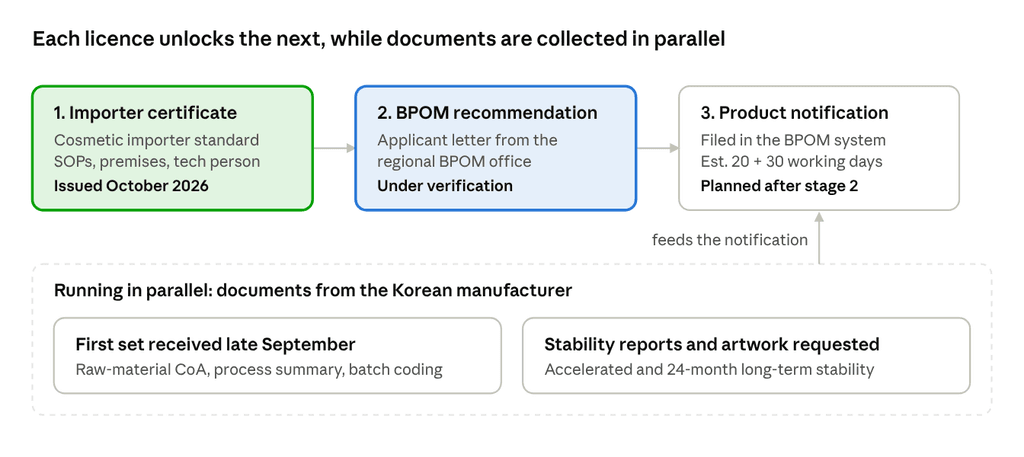
The three-stage route · status as of November 2026
The importer standard certificate is done, the recommendation letter is under verification, and the manufacturer’s documents are being gathered alongside so the notification can follow.