

For most hospital groups and manufacturers, the hardest part of bringing proton therapy, brachytherapy, or linear accelerator systems into Indonesia is not the paperwork itself. It is not knowing, early enough, that two separate regulators (Kemenkes and the Radiation Regulator) will need to review the same equipment through two very different lenses: one for market approval, one for radiation safety.
That gap in visibility is where most delays start. Applicants often secure Kemenkes marketing authorization first, only to discover that the Radiation Regulator’s bunker construction permit depends on shielding calculations tied to equipment specifications that are still being finalized. By the time the mismatch surfaces, months of schedule are already lost.
This guide is written for medical device manufacturers, hospital groups, and distributors planning a high-energy therapeutic equipment import or facility build in Indonesia. It lays out which agencies control approval, how classification and radiation licensing interact, and why running both tracks in true parallel, not just on paper, is what keeps a facility on schedule.
Why High-Energy Therapeutic Equipment Is Among Indonesia’s Toughest Registration Categories
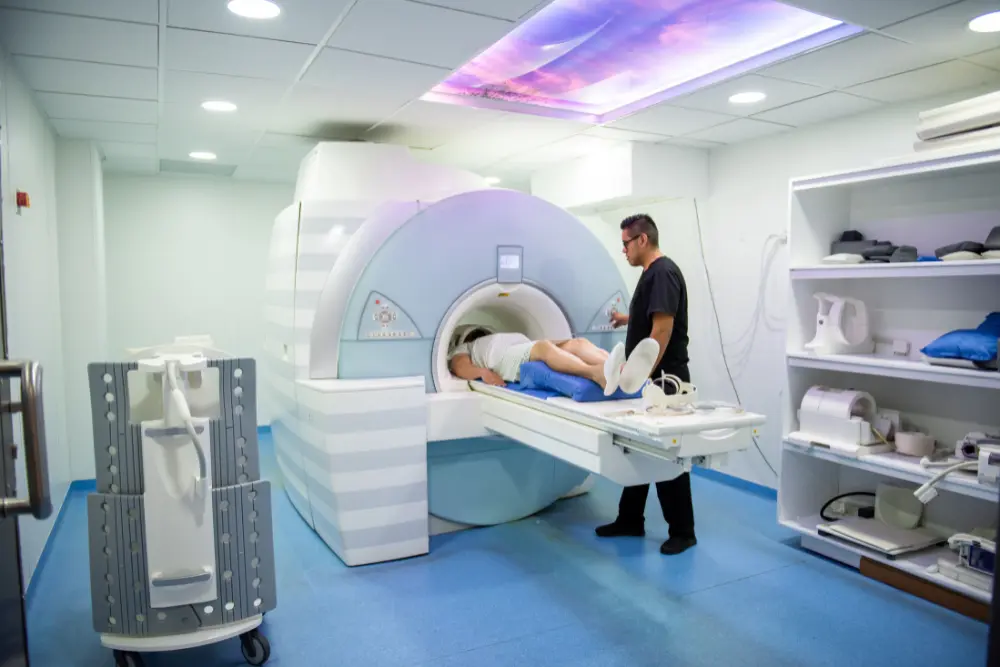
Among all medical device categories registered in Indonesia, high-energy therapeutic equipment is consistently one of the most challenging to bring to market. Proton therapy systems, brachytherapy afterloaders, and linear accelerators combine two regulatory regimes at once: medical device marketing authorization and nuclear radiation safety licensing.
The technical scrutiny Indonesia applies to this category is comparable in rigor to the assessment used across the European Union, even though the two systems are not interchangeable. Indonesia’s framework is built on globally harmonized standards, primarily the ASEAN Medical Device Directive, which itself borrows heavily from the EU and IMDRF risk-based classification model.
What Does Registering High-Energy Therapeutic Equipment in Indonesia Require?
Registering high-energy therapeutic equipment in Indonesia requires two separate government clearances. First, a Kemenkes marketing authorization, the Nomor Izin Edar (NIE), under Permenkes No. 62/2017, since these devices are generally evaluated as Class C or Class D given their potential to deliver hazardous energy, including ionizing radiation, to the body. Second, a multi-stage radiation permit from Indonesia’s Radiation Regulator under PP No. 29/2008 and PP No. 33/2007, covering facility construction and clinical operation of the ionizing radiation source.
| Track | Governing Agency | Legal Basis | What It Covers | Typical Devices |
| Kemenkes Marketing Authorization | Ministry of Health, Directorate of Medical Device Assessment | Permenkes No. 62/2017 | Product safety, quality, and benefit evaluation; issuance of the Nomor Izin Edar (NIE) | Linear accelerators, brachytherapy afterloaders, proton therapy systems |
| BAPETEN Radiation Permit | Badan Pengawas Tenaga Nuklir (BAPETEN) | PP No. 29/2008; PP No. 33/2007; Perka BAPETEN No. 3/2013 | Radiation safety review; bunker construction permit; operational permit | Same devices, evaluated as Group A ionizing radiation source utilization |
Kemenkes Classification and the NIE Pathway
Under the classification guideline issued alongside Permenkes No. 62/2017, active therapeutic devices that exchange energy with the body generally fall into Class B. Where that energy exchange is potentially hazardous, considering the nature, density, and site of application, including ionizing radiation, the device is pushed into a higher class.
This is why proton therapy systems, brachytherapy afterloaders, and linear accelerators are evaluated as high-risk equipment rather than routine active therapeutic devices. The exact classification and supporting evidence should be confirmed with a registered regulatory consultant before dossier preparation begins, since misclassification at filing stage can trigger a full resubmission.
A valid NIE under Permenkes No. 62/2017 is mandatory before any importation, sale, or distribution, and it is valid for a maximum of five years from issuance. Distributing without one is a violation under Undang-Undang No. 17/2023 tentang Kesehatan, Pasal 143 ayat (1), and it carries administrative sanctions.
Radiation Regulator Safety Permit
Radiotherapy activity, including external beam treatment and remote afterloading brachytherapy, is classified under PP No. 29 Tahun 2008 tentang Perizinan Pemanfaatan Sumber Radiasi Pengion dan Bahan Nuklir as a Group A ionizing radiation utilization. This places it under the Radiation Regulator’s strictest licensing tier.
Perka BAPETEN No. 3 Tahun 2013 tentang Keselamatan Radiasi Dalam Penggunaan Radioterapi sets out the radiation safety requirements, licensing conditions, and reporting obligations specific to radiotherapy. Licensing runs in stages, starting with a construction permit for the treatment bunker, followed by a separate operational permit once the facility passes field verification.
PP No. 33 Tahun 2007 tentang Keselamatan Radiasi Pengion dan Keamanan Sumber Radioaktif provides the underlying radiation safety and security standards that the Radiation Regulator applies at both the construction and operational review stages.
If a Device Is Approved in Europe, Can It Be Registered in Indonesia?
A CE mark, or an approval already secured in the European Union, does not transfer automatically. Indonesia’s classification system is harmonized with international frameworks, so a device with a solid EU technical file has a real head start, but Kemenkes still requires a fully localized dossier.
That localized dossier includes Bahasa Indonesia labeling, an appointed local license holder, and documentation formatted to Indonesia’s own templates rather than the EU Medical Device Regulation structure. The same principle applies at Indonesia’s Radiation Regulator, which evaluates the radiation source and shielding design against Indonesian safety regulations regardless of prior EU or Japanese approval.
How Big Is Indonesia’s High-Energy Therapeutic Equipment Market?
Indonesia’s demand for advanced radiotherapy capacity is large and still developing. As of December 2025, proton therapy technology was not yet clinically available anywhere in the country, according to Eka Hospital’s Eka Tjipta Widjaja Cancer Center, which is targeting Indonesia’s first operational proton therapy center for 2027.
Separately, RS Kanker Dharmais has pursued a technology transfer partnership with the Medipolis Proton Therapy and Research Center in Japan to build local proton beam capability. Both efforts point to the same underlying driver: a large population of cancer patients currently traveling abroad, mainly to Japan, Singapore, and Malaysia, for treatment that is unavailable at home.
For linear accelerators and brachytherapy afterloaders specifically, demand is more established, since these already form the standard of care across Indonesia’s growing network of cancer centers. Manufacturers and distributors entering this segment are not pioneering a new market category. They are competing for share in an active, tightly regulated one, where every unit sold still needs its own Kemenkes and radiation permit file.
Registration Timeline: What Actually Drives the Delays
In our experience, three factors most often determine how long combined Kemenkes and radiation clearance takes for this category:
- Whether the Kemenkes NIE dossier and the Radiation Regulator’s construction permit are filed in parallel or sequentially
- Locations unsuitable for their intended zoning when registering High-Energy Therapeutic Equipment in Indonesia (such as Proton Therapy, Brachytherapy, and Linear Accelerators).
- Whether shielding and bunker design are finalized before, not after, the equipment specification is locked with the manufacturer
- Whether the applicant already has an accredited local license holder and Radiation Protection Officer arrangement in place, or needs to build one
None of these factors are fixed by regulation alone. They depend on how the application strategy is structured from day one, which is why timeline planning for this category should sit with a regulatory partner rather than be estimated in isolation.
Common Pitfalls We See With This Category
- Treating the Kemenkes and Radiation Regulator applications as one combined process, when they are legally and procedurally separate filings with different reviewers
- Assuming a CE-marked device only needs translation, when Indonesia’s dossier structure itself differs from the EU MDR technical file format
- Finalizing zoning-compliant site selection for registering High-Energy Therapeutic Equipment in Indonesia (such as Proton Therapy, Brachytherapy, and Linear Accelerators)
- Finalizing bunker architecture before confirming final beam energy and source specifications with the equipment manufacturer
- Underestimating the local license holder’s ongoing reporting obligations once both the NIE and the radiation permit are issued
Getting the Kemenkes–Radiation Regulator Sequence Right
Getting this category right in Indonesia depends less on any single form and more on how early the Kemenkes and Radiation Regulator strategy comes together. Applicants who sequence both tracks from the outset, rather than treating them as sequential steps, consistently move faster than those who file first and adjust later.
That sequencing covers more than paperwork. It means confirming beam energy and source specifications with the manufacturer before bunker architecture is finalized, lining up an accredited local license holder and Radiation Protection Officer arrangement early, and building the Kemenkes dossier and radiation permit application as one coordinated strategy rather than two unrelated filings.
Given how much is at stake in getting the sequencing right, the strongest position is to have both tracks mapped out before a single document is submitted, not after issues surface mid-review.
This kind of sequencing is exactly what our Radiation Medical Device Registration service is built to support, with a focus on high-energy and radiation-emitting equipment specifically. Manufacturers working through the broader Class C and Class D device pathway alongside radiation licensing will find that ground covered under our Medical Device Registration service, which handles the end-to-end Kemenkes process from classification through post-market reporting. For a closer look at how radiation-related pathways compare across device types, our related article on Radioactive IVD Registration in Indonesia is worth a read as well.
Ready to Start Your Registration?
Planning to bring proton therapy, brachytherapy, or linear accelerator equipment into Indonesia? Getting the Kemenkes and radiation permit sequencing right from the start can save months of avoidable delay. Contact our team using the form below, and we will help you map out the right strategy for your equipment before you commit to a filing timeline or a bunker design.